
This white paper focuses on the future benefits of offsite construction.
As part of the Proctor Group Technical presentations, a round table discussion was held with a group of UK technical professionals to explore the offsite construction sector and provide an open and frank discussion on the sector as a whole.
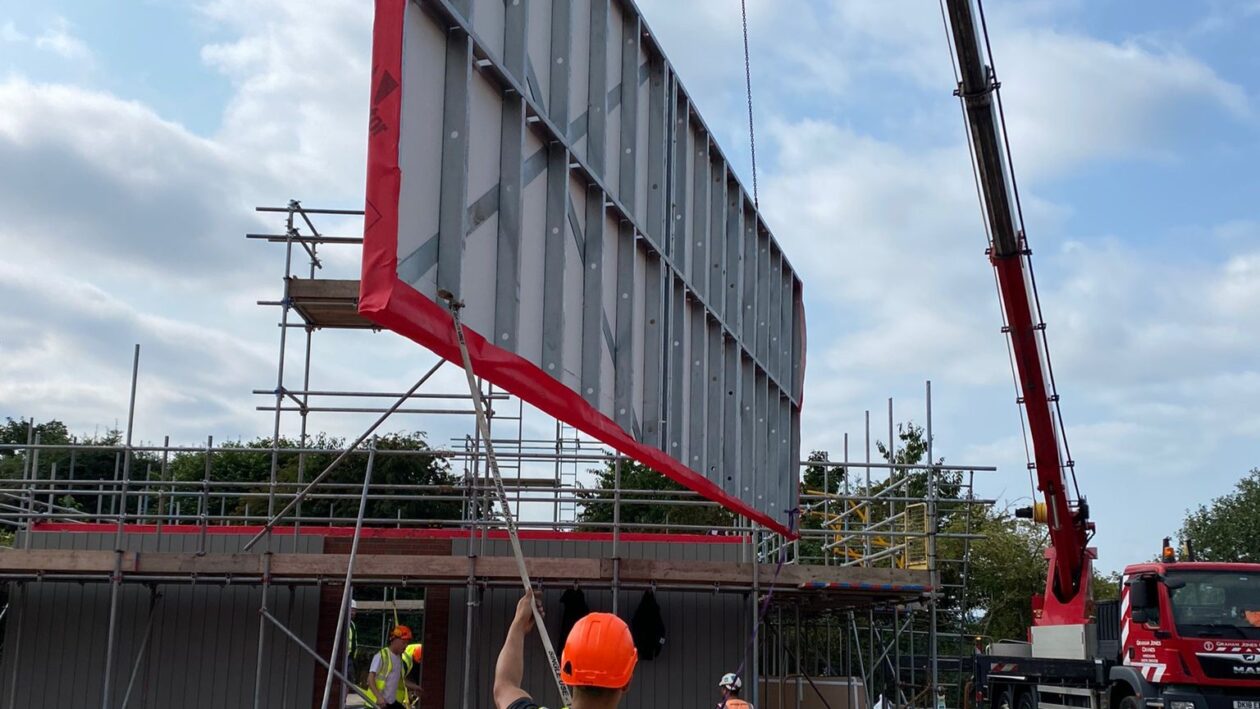
Contributors
- Clare Fenton, Specialist Building Envelope Consultant, Fenton Partners Limited
- Nathan Beattie, Commercial Operations, Beattie Passive
- Sean Gilbert, Head of Supply Chain, Modulous
- Steve Chesters, Commercial Director, Hadley Group
- Will Jones, Business Development, The A. Proctor Group
- Keira Proctor – Managing Director – A. Proctor Group Ltd (Host)
Summary
The Benefit of Opportunity: A New Model to Sit Alongside Existing Methods
The future benefits of offsite construction are positive, but only if those involved capitalise on the opportunities this can bring. It is a chance for the construction industry to step aside from current construction methods and create a new model with clear rules and governance to run alongside existing methods. It does not matter how we package it, offsite, modular, platform, or MMC, we have the chance to embrace quality, repeatability, reliability, accountability, innovation, speed, value, and skills.
The Benefit of Quality
We need to ensure that we are delivering the best possible standard. An example of this can be demonstrated by the approach of Beattie Passive Build Systems. On each build, the aim is to achieve Passivhaus standards as a minimum. All U-values are 0.11, and airtightness is below 0.6. To achieve this, the highest quality build is required. All engineers follow standard operating procedures and are not allowed to move on to the next build stage until a Technical Supervisor has signed the build off to ensure it is built to the correct requirement. This cannot happen effectively on site and is a massive benefit of offsite construction.
The Benefit of Speed
Offsite construction can significantly increase the delivery of new homes and buildings, speeding up the build process and minimising delays on site caused by bad weather and other factors. Offsite construction drives efficiencies within the build process that are not possible through traditional build methods.
The Benefit of Certainty of Cost
Another major benefit of offsite construction is the ability to give price certainty to clients on precisely what the house or building will cost. Because you are working in a controlled environment and striving to improve efficiencies, you can guarantee the price and stick to it. Current prices in the UK are spiralling and uncontrollable, which can create a very difficult environment for traditional builds. Those working in offsite construction can maintain prices and give clients certainty.
Reduced Waste in the Move to Net Zero
As we move into a Net Zero transition economy, offsite construction can offer benefits through BIM modelling, material optimisation, and the minimisation of waste materials. Offsite construction can also take full loads of materials instead of buying materials in smaller batches, which can reduce the number of deliveries.
Simplification of Procurement and Supply Chain
The simplification of procurement and supply chain relationships, along with the benefits of product repeatability within controlled manufacturing environments, is a real focus of offsite construction. The supply chain strategy can be kept simple. At Modulous, for example, the aim is to remove duplication and any unnecessary or non-value-added margin, while building long-term relationships that deliver value and innovation. In construction, there is still plenty of over-complication within the supply chain, such as the more traditional approach of tendering rather than partnering through relationship management. Ultimately, this limits innovation and the sharing of ideas. Modulous seeks to address this by engaging more broadly across the industry and collaborating with like-minded people on how to share ideas, simplify processes, and optimise delivery. Modulous uses a decentralised model, which effectively means they are asset-light and do not have their own factory. They partner with the supply chain and collaborate to deliver sub-assemblies and repeatable products. All of this takes place in a controlled environment that mitigates risk and ensures quality.
Removing the Barriers to Expansion
Offsite is still a rapidly expanding market because the construction sector is continuing to grow. Offsite construction is also a very dynamic form of construction. When we consider the potential of the construction sector to expand, we need to take into account the restrictions. What is stopping it from being able to expand quickly and react effectively? With offsite construction, many of those barriers are removed, and the norm is reset. For example, if you needed 15 skilled electricians on the traditional build of a large house, the same project in an offsite or modular factory would need nowhere near that amount. The labour resource is a benefit, and the training of that labour is far easier to do in a controlled factory environment. The benefits of offsite construction are therefore significant across the entire supply chain, from the top down.
High-Performance Products for Offsite
As a supplier of construction membranes, such as acoustic flooring and high-performance insulation, the A. Proctor Group says that it is important for material manufacturers to understand not just how offsite projects are built, but also how they are designed and how they can add value. Key questions include how to mitigate condensation, improve airtightness, and protect the finished product from water ingress and UV transportation. Offsite construction can improve the construction industry, the economics of delivery, the spatial aspects, the timing of installations, and the building process. Most importantly, it can improve performance. The focus on high performance is essential for offsite construction and offers a strong foundation for the future of the UK construction sector.