
The construction industry has a twin-pronged challenge: address a skills shortage, and raise standards of competence. Keira Proctor, Managing Director at Proctor Group, relates some of the company’s recent experiences in learning more about the challenge, and finding ways as a product manufacturer to contribute to solving it.
Like a lot of tradespeople, James Brown got his start in the construction industry through the family business. “My father had a building firm, so I was on site mixing concrete at the age of 12!” he admits.

From there, he became a stonemason and worked on a host of roofs, including cathedrals. Now off the tools, he is Roofing Tutor at Optimum Skills Ltd, an independent training provider in north east England. Through their three Construction Academies , Optimum Skills offer courses in all aspects of pitched roofing (slating and tiling) and flat roofing, as well as bricklaying, joinery and groundworks.
Obviously, employing teenagers on building sites is not good practice. James’s story is both a sign of a different time and a reminder of the construction industry’s need to attract, and then retain, people who might not otherwise have considered a career in the sector.
Blending the modern and the traditional
James describes himself as “very traditional” but also understands the need to adapt: “I came into teaching because you can’t stick with what you’ve got. Legislation changes frequently, there are lots of systems and lots of ways of doing things. Below traditional finishes are modern products.”
For that reason, Optimum Skills seek product manufacturers willing to help support the apprentices’ learning. Rachel Armstrong is the Partnerships Manager at Optimum Skills.
“We’ve always tried to do partnerships,” explained Rachel. “Just as we look for skilled tradespeople to come and be tutors, we also look for manufacturers to come and share their knowledge.”
Being an independent training provider, Optimum Skills finds itself competing for visibility with better-known or more established colleges. Collaborating with noted construction industry names “adds prestige” (in Rachel’s words), and gives Optimum Skills the flexibility to do things differently.
“We like anything that adds value,” said Rachel. “The apprentices will be using these products on site in future, so it all helps. We appreciate the support, and want to celebrate the willingness of the industry to give their time and materials.”
James agrees: “Knowledge from companies is vital. It comes to the learners and then goes out into the industry. Working with manufacturers is all about collaboration, and you can tell when companies buy into that. Those are the relationships we want to maintain.”
Avoiding ‘death by PowerPoint’
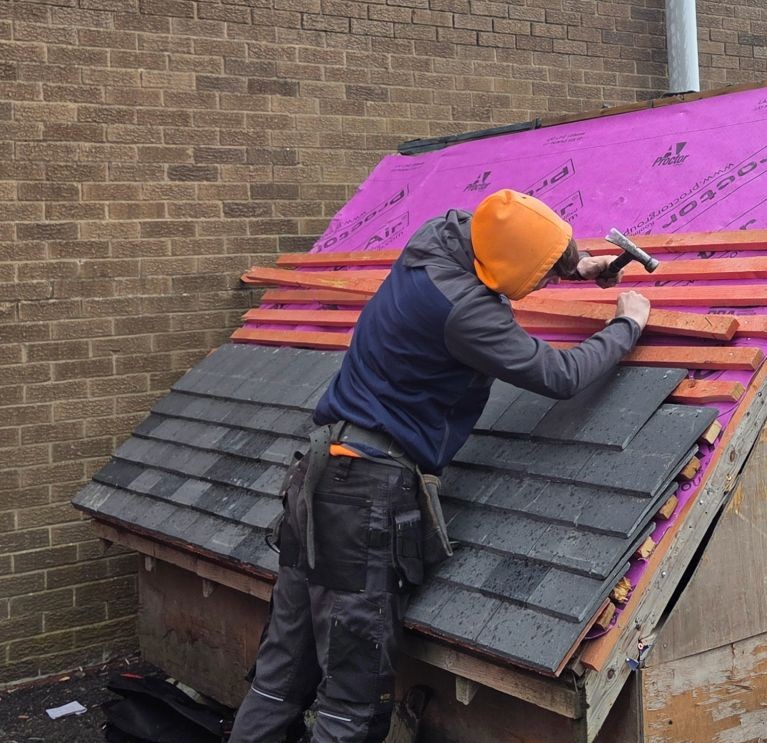
Proctor Group was approached by Optimum Skills and we recently supplied them with some rolls of our air permeable pitched roof underlay, Proctor Air®. Joe Fixter, our Regional Sales Manager (North East), has also begun delivering training sessions about the theory of physics in roofs.
“What Optimum Skills do, training the installers of tomorrow, is really important, so it’s nice to work with the apprentices,” Joe commented. “It’s much more useful for them, having the space to explain the theory behind underlays, rather than relying on them being told on site.”
As part of the session, Joe demonstrates the bubbler, a device that lets people see the air permeability of Proctor Air with their own eyes.
“We’re tradespeople, so we want to be hands on,” said James Brown. “I’m very against ‘death by PowerPoint,’ and you could see faces light up when the bubbler was shown.”
The training sessions don’t just benefit the apprentices either, as Joe explained: “I’ve got a lot of construction industry experience, but from my point of view it’s invaluable to understand more about the practicalities of roofing. The practical sessions we did with the rolls of Proctor Air were a great chance to ask the apprentices questions and for them to show me what they were doing.”
Training as part of structured growth and future planning
Some 270 miles away from Optimum Skills, in Oxfordshire, the reroofing of a church has recently been completed by Speakman Roofing. The company used Proctor Air as the underlay, and we spoke to the Director, Andrew Speakman, for a case study.
During our correspondence, we noticed that Speakman Roofing has a member of staff with the title of Training Manager. Intrigued, we took the time to ask Andrew about the role.
“It’s about growing the business in a structured way,” Andrew explained. “When we’ve expanded in the past, it has been in an unstructured way. I’ve tried to remedy that by changing how we hire people and planning for the future.”
As a result, Speakman Roofing now takes on one or two apprentices a year and puts them through formal training. Their learning complements the knowledge and experience of the skilled team leaders.
“We all know getting people to do things differently to how they’ve always done them is hard,” said Andrew. “Fortunately, our older guys were all trained. But when people haven’t been formally trained then there might be no consistent standard to completed work. By putting our young people through training, we’re giving them a baseline of skills they can apply to different types of projects.”
This aligns with what James Brown told us about working with apprentices as a tutor: “I tell the students to explain what they’ve learnt to the people they work with. Sharing the knowledge makes a difference. In smaller firms especially, they’ll take it on board. When everything comes down to reputation, they’re looking for better ways of working.”
Competence and organisational capability
Speakman Roofing’s approach stands them in good stead generally, and especially in terms of meeting their responsibilities under the Building Safety Act.
The Act applies to projects of all size and scale, domestic and non-domestic. Under the Act’s competence requirements, organisations “must be able to demonstrate they have the organisational capability to carry out their duties and undertake the work .”
Roofing contractors are not exempt from this, so must have policies, procedures and systems in place to make sure their employees comply with all relevant regulations.
Although completely unrelated to our work with Optimum Skills, chatting to Andrew Speakman provided valuable extra insight on training in the roofing sector. The conversation reinforced the importance, and the national relevance, of what we’re learning from being in a classroom with apprentices in Gateshead.
Cooperation and information sharing are underpinning principles of the Building Safety Act. Clients, designers and contractors have legal responsibilities to share information and be honest about their competence.
The rest of us in the construction industry must buy into that approach equally, contribute in our own ways, and be humble enough to recognise where we need to make improvements. Doing so, and then telling stories like these, shows how better communication and collaboration benefits competence and benefits the construction industry.
Related Products

Wraptite® – Vapour Permeable Air Barrier
Probreathe® A2 – Vapour Permeable Breather Membrane

Procheck® A2 – A2 Fire-Rated Air and Vapour Control Layer
Latest Articles


Related Projects

Lightburne: Wraptite® for Airtightness and Wind Resistance in Apartment Facades

Priory Fields: Proctor Air® for Condensation Control in High-Specification Homes

What Difference Does the Right Roofing Supplier Make?

How Can Membranes Improve Offsite-Manufactured SIPs?
Latest News



Request a Sample

Technical Advice

CAD Detail Review

U-Value Calculation

Book a CPD

Specification Check